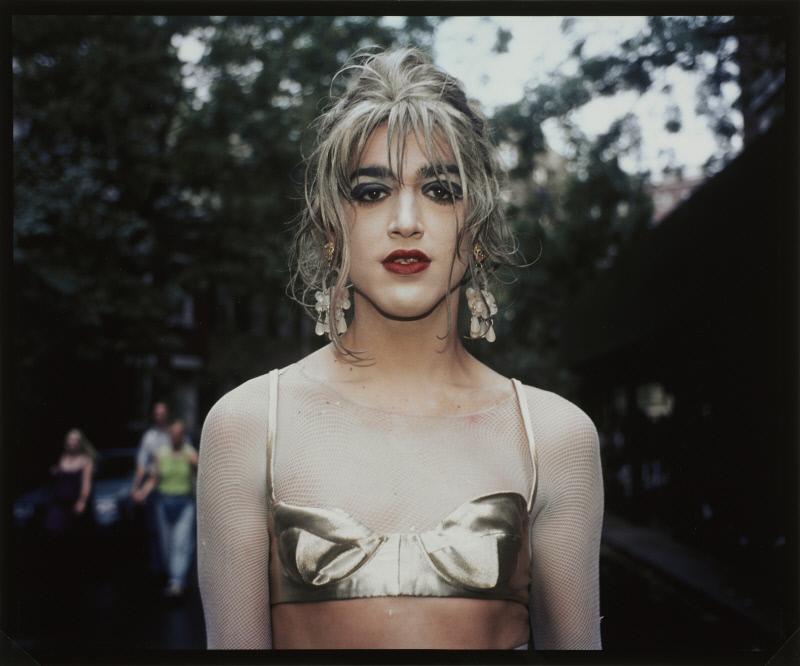
Nan Goldin (American, born 1953)
Jimmy Paulette After the Parade, New York, 1991
Cibachrome Print
Gift of Steven Neu, class of 1994, in memory of Faith Waterman, class of 1928
2008.30
In both its subject matter and photographic approach, Nan Goldin’s Jimmy Paulette After the Parade embraces the spaces between binaries. The photograph depicts Jimmy Paulette, New York City drag queen and friend of Nan Goldin’s, wearing heavy eye makeup, red lipstick, a wig, a cropped fishnet top, and a gold bra. Jimmy Paulette faces the camera directly and appears starkly bright against a dark background. Goldin made a number of photographs of Jimmy Paulette before and after the 1991 New York City Pride Parade. These images depict her friend in various stages of preparation and undress surrounding drag performance. Ultimately, Goldin included photographs of Jimmy Paulette in her larger body of work about drag queens, originally published in the book, The Other Side (1993). While this photograph recalls Diane Arbus’s Young Man in Curlers at Home on West 20th Street, N.Y.C. (1966) in its subject matter, use of flash, and frontal composition, Goldin was not interested in exoticizing or othering drag queens. Jimmy Paulette is not framed as a performer caught in the midst of a strange act, but rather as a person exploring their own identity and androgynous gender performance. Further, Goldin positions herself not as an outside observer, but as an active participant in the queer and experimental underground cultures she photographs.
Goldin’s use of a close-up flash and the color-saturated cibachrome printing technique reflect shifting attitudes about fine art photography during the second half of the twentieth century. Best known for her work The Ballad of Sexual Dependency (1986), Goldin embraced the aesthetic of the snapshot as a means of underscoring her intimate and personal relationships with her subjects. In a 2020 conversation with David Pinckney, Goldin described making photographs like Jimmy Paulette After the Parade, New York as an act of documenting her chosen family – a visual diary: “I didn’t photograph people I didn’t love. I had to feel a connection.” Goldin originally showed her work in slideshows in clubs in New York City. These slideshows were evolving performances; Goldin tinkered with different sequencing, soundtracks, and images each time she presented the work. She invited her friends and manually flipped through individual slides of images of the very people and community watching.
Today, Goldin’s work is recognized for both its intimate, empathetic depictions of urban subculture and for expanding the narrative and aesthetic possibilities of art photography. Goldin explains that she made these photographs in order to make her experiences and friends tangible and remembered. In the wake of addiction crises and the AIDS pandemic, these photographs have become testaments of loss, both in Goldin’s own life and in the LGBTQ+ community as a whole. Ultimately, Jimmy Paulette After the Parade makes visible both Nan Goldin’s subjective memories and Jimmy Paulette’s own identity.
Cassie Jain, Loeb Post-Baccalaureate Curatorial Fellow, Fall 2020
Further Reading:
- David Pinckney, “The Ballad of Nan Goldin: A Conversation with Darryl Pinckney,” Ballads: Aperture 239 (New York: Aperture Foundation, 2020).
- Hilton Als, “Nan Goldin’s Life in Progress,” The New Yorker, July 4, 2016.
- Jonathan Schroeder, “Snapshot Aesthetics and the Strategic Imagination,” InVisible Culture: An Electronic Journal for Visual Culture, Issue 18: Making Sense of Visual Culture (Spring 2013).
- Nan Goldin, The Other Side (New York: Scalo in association with D.A.A.D Artists-in-Residence-Programme, Berlin, 1993).
- Oihana Garro-Larrañaga, “Art and Identity Construction: Reflections about family narratives with Nan Goldin,” Arte, individuo y sociedad, Vol. 26, Issue 2 (May 2014).
- “Q&A with Nan Goldin and Gregory Crewdson,” Yale MFA Photography, May 10, 2020, video, 35:22. https://www.youtube.com/watch?v=rJKe4IZBZIQ
- Sarah Rudy, “‘A Radiant Eye Yearns for Me’: Figuring Documentary in the Photography of Nan Goldin,” Feminist Studies, Vol. 35, No. 2 (Summer 2009), pp. 347-380.
- United By AIDS: An Anthology on Art in Response to HIV/AIDS, ed. Raphael Gygax & Heike Munder (Zurich: Scheidegger and Spiess, 2019).
