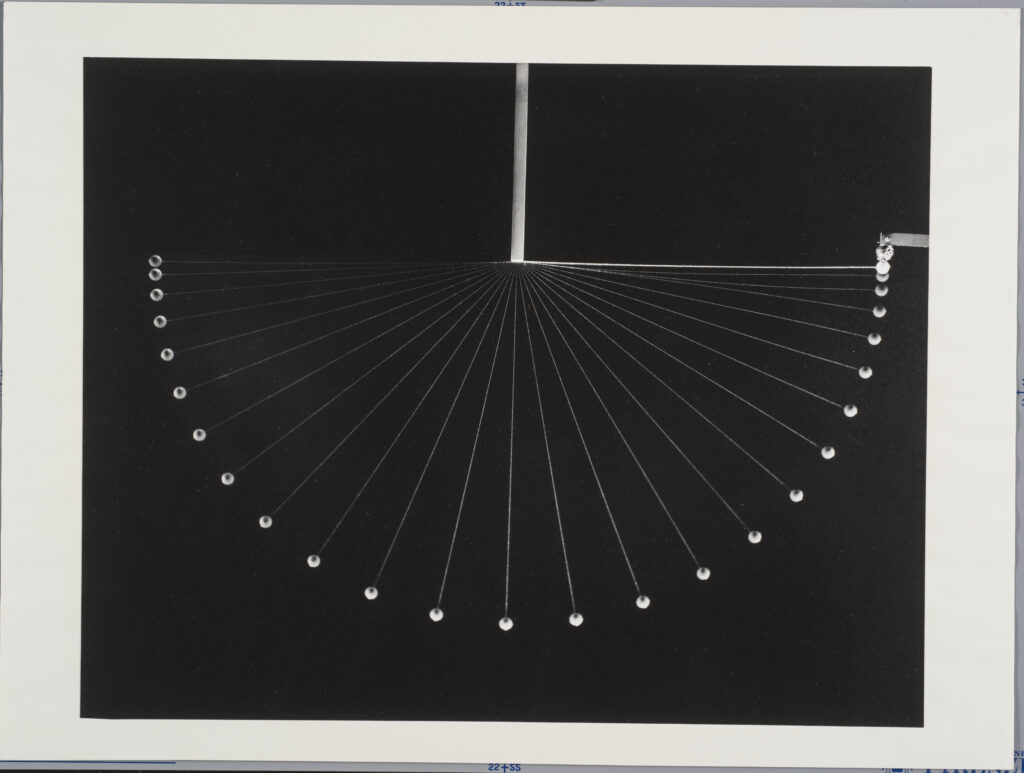
Berenice Abbott (American, 1898-1991)
Transformation of Energy, 1958
Gelatin silver print
Purchase, The Charles E. Merrill Trust Fund
1973.22.7
This photograph, depicting the parabolic path of a pendulum, was made by Berenice Abbott in 1958 as an illustration for a high school physics textbook. While this striking and simple image, with its eye for line and geometric shape, shares a modernist aesthetic sensibility with Abbott’s more famous urban photography, its subject matter, a scientific principle, is startlingly different. Abbott, however, was a prolific, innovative, and devoted science photographer. After finishing her documentary project of New York City, titled Changing New York, in 1939, Abbott found herself searching for a new artistic challenge. She chose to pursue science photography.
In a 1939 letter to friend and ecologist Dr. Charles C. Adams, Abbott explained her decision to focus on science photography. According to Abbott, the modern world was “made by science.” Despite this, most people were unfamiliar with basic scientific principles. Photography, Abbott argued, was especially well suited to bridging the gap between scientists and average people. Not only did photography, invented through scientific experimentation, possess a basic kinship with science, it was a familiar format that most people could understand. Photography could and, Abbott argued, should serve as an imaginative interpreter of science for lay people. It seems that Abbott saw this transition as more than a mere career shift, it was an artistic, socially conscious mission. In many ways, this most recent development of Abbott’s career was a logical outgrowth of her previous work. It would allow Abbott to produce the documentary, practical, and yet aesthetically compelling images she felt to be photography’s strength, in the cause of a subject, science, that she thought important and found personally fascinating.
Having committed to this mission, Abbott began work as an illustrations editor for Science Illustrated as well as a freelance science photographer of her own, producing images that were reproduced in popular science magazines as well as a high school biology textbook. However, it was through Abbott’s work with the Physical Sciences Study Committee (PSSC) in the late 1950s that her science photography reached its greatest heights.
The PSSC was a product of Cold War anxieties. On October 1st, 1957, the Soviet Union launched Sputnik 1 into orbit, igniting a deep anxiety over the U.S.’ lack of comparable space technology and the state of American science education. Fearing that the Soviet Union’s lead in space technology could be linked to the U.S.’ poor physics curriculum, the U.S. government created the PSSC to evaluate and improve American physics education. The committee’s main project was to create a new high school physics textbook that focused on abstract concepts over simple applications. When Abbott heard about their project, and their need for an illustrator, she leapt at the opportunity. The PSSC hired her eagerly.
Abbott adored her work with the PSSC. Through a combination of innovative usage of photographic technologies, meticulous trial and error, and creative thinking, Abbott made aesthetically compelling and legible representations of the abstract phenomena studied in the textbook. Her photographs became explanations. This image, illustrating a pendulum’s path, depicts how the potential energy of the pendulum (which is greatest at the beginning and end of the pendulum’s path) is transformed into kinetic energy (which is greatest at the nadir of the pendulum swing) and vice versa. The image makes an abstract idea about the nature of energy more concrete through its visually compelling imagery and composition. Abbott’s use of multiple exposures on the same frame allows the object’s movement to be legible not only through space, but through time as well, giving the viewer and idea of how speed (the space between the individual images of the pendulum) increases and decreases through the pendulum’s path. While effective, this technique was not innovative. Indeed, Harold Edgerton, a professor of Electrical Engineering at MIT, the institution that hosted the PSSC, had, in the past decades, invented the stroboscope, which allowed such images to be made more easily. Earlier still, the French physiologist Etienne-Jules Marey had, in the latter half of the 19th century, used the same technique to study the movement of people and animals. Indeed, the aesthetic quality of Marey’s purely utilitarian images were inspiring for modernist artists like Abbott. In this image, Abbott was accomplishing what Marey had decades earlier: images that were both purely pragmatic and also visually compelling. Abbott’s photos for the PSSC met widespread acclaim. Appreciated by the scientists at the PSSC, they were raved over by Abbott’s art world contacts and were even parlayed into a traveling exhibition by the Smithsonian Institute that toured the nation.
Through her work at the PSSC, Abbott made abstract science concrete in a visually compelling and imaginative way. It was the marriage of science and photography that Abbott had hoped for: Her photographs acted as ambassadors, communicating and explaining science to laypeople. Abbott’s works are a testament to the powerful role photographs can play in communicating scientific ideas. A compelling image, as the saying goes, is worth a thousand words, it is easier to understand and more immediate. Abbott brought that simple immediacy to bear in her photographs of abstract physics, making them clear and simple. In doing so, Abbott democratized art photography, by making it simple and practical, and science, by making it more legible.
Photography is a great communicator of science, and Abbott is perhaps one of the preeminent science photographers. Her effective attempts to make science visible demonstrate the fruitful relationship that can exist between science and photography as an intermediary, providing important inspiration in a time when poorly communicated science has led to misunderstandings that have caused science and scientific findings to be viewed with increasing suspicion and, even, hostility.
John Mahoney, Loeb Curatorial Research Intern, Summer 2020
Further Reading and Viewing:
- Berenice Abbott, Berenice Abbott. Edited by Ron Kurtz. Gottingen: Steidl, 2008. (Note: two volumes)
- Berenice Abbott, “Berenice Abbott: Science and Photography.” Accessed July 13th, 2020. http://seeingscience.umbc.edu/2016/10/berenice-abbott-photography-and-science-1939/
- Abbott, Berenice. Berenice Abbott: Changing New York. Edited by Bonnie Yochelson. New York: The New Press, Museum of the City of New York, distributed by W.W. Norton and Co., 1997.
- Berenice Abbott, Documenting Science. Edited by Ron Kurtz. Gottingen: Steidl, 2012.
- Marvin Heiferman, “Author Talk: Marvin Heiferman on ‘Seeing Science: How Photography Reveals the Universe.” Filmed May, 2019 at the Aperture Foundation, New York City, New York. Video, 37:23. https://www.youtube.com/watch?v=rTIdEnHpPUk
- Hannah Star Rogers, “Making Science Visible: The Photography of Berenice Abbott.” Accessed July 13th, 2020. http://photomediationsmachine.net/2015/03/24/making-science-visible-the-photography-of-berenice-abbott/
- Shini Somara, “Work, Energy, and Power: Crash Course Physics #9.” Posted May 26th, 2016. Video, 9:54. https://www.youtube.com/watch?v=w4QFJb9a8vo&list=PL8dPuuaLjXtN0ge7yDk_UA0ldZJdhwkoV&index=10
- George Sullivan, Berenice Abbott: Photographer. New York: Clarion Books, 2006.
- Julia Van Haaften, Berenice Abbott: A Life in Photography. New York and London: W.W. Norton and Company, 2018.
